

How Choose and Maintain Your Oil Storage Tanks
Oil tank owners have a legal duty to ensure fuels and oils are stored safely and securely. Without regular maintenance and the correct storage conditions, your fuel tank can easily become a liability rather than an asset.
This guide is helpful for anyone who has recently had a fuel storage tank installed or simply needs to update or refresh their knowledge, showing you the risk factors that you need to look out for and what you can do about them.
The benefits of an on-site oil storage tank
An on-site storage tank is ideal for businesses that use large amounts of fuel or when oil barrels (drums) are too small or inconvenient. An on-site storage tank can save you time by not having to make frequent fuel orders, as well as reduce regular delivery costs and improve efficiency within your operations.
Having an on-site storage tank also allows you to buy fuel in bulk, which helps to reduce the price you pay per litre. Companies can also benefit from fuel management systems, such as oil tank telemetry monitoring, allowing them to control and monitor fuel consumption to further help reduce costs.
Oil storage tank types
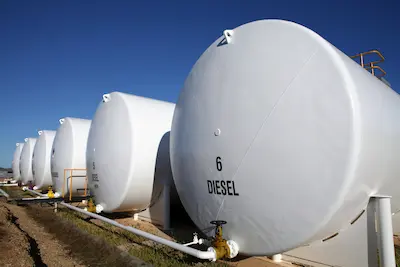
There are two types of oil storage tanks available: steel and plastic. Both have different advantages; some fuel users prefer the non-rusting properties of plastic storage tanks, whilst others are drawn to the strength and robustness of steel tanks.
At Crown Oil, we supply both plastic bunded oil storage tanks and steel bunded oil storage tanks in a range of sizes across the UK. To help you decide which oil storage tank is best for you, we’ve compiled the pros and cons of both types below.

Plastic oil storage tanks
Plastic fuel storage tanks are a popular choice, especially for domestic use, as they are cheaper and don’t rust like steel storage tanks.
Benefits of plastic oil storage tanks
- Constructed from polyethene, making them less prone to corrosion than steel storage tanks
- A lightweight solution
- Fully compliant with all regulatory requirements
- A variety of off-the-shelf sizes
- Easy to install and manoeuvre
- Plastic is an insulator, so there’s a reduced risk of contamination
- Deformed storage tanks can regain their original shape, provided there are no cracks
- Readily available and fully bunded
Drawbacks of plastic oil storage tanks
Once a plastic storage tank is damaged, you have no choice but to replace it, which can be costly and inconvenient. A cracked fuel tank not only puts the environment and wildlife at risk, but it also puts your fuel at an increased risk of contamination and spillage.
A damaged storage tank also increases the risk of water formation inside a fuel storage tank, which encourages diesel bug growth. This can clog filters, injectors and fuel lines, and lead to a sudden and expensive halt to your operations.
Plastic tanks can crack due to several reasons:
- Cold weather – splits and cracks are common in low temperatures and from bouts of snow, putting the environment and wildlife at risk
- Temperature fluctuations – plastic storage tanks undergo huge stress when located outside, from weather and temperature fluctuations
- UV exposure – sunlight can cause whitening and discolouration, which can lead to twisting, bowing and expanding of the plastic
- Stress – Plastic storage tanks can crack and shatter under heavy strain, from being installed on an uneven base or through the weight of snow or organic debris
- Accidental damage – In high traffic areas, such as business yards, plastic storage tanks are at greater risk of irreparable damage than a steel storage tank would be able to withstand

Steel oil storage tanks
Steel storage tanks are usually used to store bulk amounts of fuel due to their desirable characteristics when compared to plastic tanks.
Benefits of steel oil storage tanks
- Sturdier and more resilient than plastic, so it can withstand greater impacts on-site
- Non-porous, meaning they won’t absorb any of their contents
- Fully compliant with all regulations
- Available in standard and bespoke sizes
- Can be repaired and patched, unlike plastic storage tanks
- Much longer lifespan than plastic storage tanks
Drawbacks of steel oil storage tanks
The properties of a steel storage tank also mean that they are more prone to corrosion from varying weather conditions, such as UV light, heat and condensation. These fluctuations can cause chemical or electrochemical reactions between storage tanks and the environment, and over time, lead to tank corrosion.
If ignored, corrosion not only causes the storage tank’s contents to degrade in quality but also negatively affects the tank’s integrity. This will eventually penetrate the storage tank structure, causing problems such as tank bottom perforation. If oil escapes through the storage tank’s walls, you risk damaging the environment, as well as expensive clean-up costs and voided warranties.
Crown Oil Fuel Storage Tanks
Wide range of plastic and steel bunded fuel storage tanks we can supply and install
Storage Tank Maintenance Checklist
We’ve put together a handy list which you can use when conducting your own checks
Regulations for on-site oil storage tanks
There are different regulations that apply to fuel storage tanks, depending on the fuel stored, where they are located and how much you’re storing. To help untangle the red tape and ensure you’re operating within the law. Our expert team put together a dedicated oil storage and installation regulations guide to help both commercial and domestic users stay within the law.
Common oil storage tank issues
External temperature fluctuations
Unfortunately, it’s quite common for water to get inside a fuel storage tank, particularly during the spring and summer, due to heat gain and evaporation. When the external temperature increases, condensation can form internally and cause the storage tank to “breathe”. This accelerates contamination by causing water and bacteria to accumulate.
FAME content in fuels
Fuel storage tanks also face a number of issues due to the nature of the products stored. The introduction of ultra-low sulphur diesel (ULSD), paired with the increase in bio (FAME) content and modern refining techniques, has led to a widespread increase in contamination issues. These microbes sink to the bottom of the tank and build up with rust and dirt, resulting in sludge forming on the base of your tank.
Over time, this can lead to hidden flaws, cracks and corrosion developing in the structure of your storage vessel. Even minor damage to any storage tank can hugely increase the risk of a tank failure. If left unmonitored, it can lead to an accidental oil spill, which can have a significant negative impact on the environment and your bottom line.
While many different types of corrosion can occur, the majority are not visible by exterior examination and further internal testing, such as Non-Destructive Testing, is required.
In 2018, the UK experienced an extremely cold winter, which was followed by a particularly warm and dry summer. This led to a 23% rise in callouts to instances of corrosion and reports of fuel contamination.
Storage tank servicing and maintenance
Storage tank owners have a legal duty to ensure that the fuel stored is safe and secure without posing a risk to the environment. Spills and leaks are extremely expensive to clean up and can contaminate nearby groundwater supplies, building foundations, local wildlife and their habitats.
The ongoing care of your storage tank is imperative. If you have any concerns about your oil storage tank, you must contact your fuel supplier or an OFTEC-registered engineer as soon as possible.
Ongoing oil storage tank care
You should carry out regular maintenance yourself to help ensure your tank lasts longer and is less likely to need expensive repairs or replacements.
A few simple checks now can save you thousands of pounds in the future. Signs of wear and tear include:
- Corrosion and rust
- Splits, discolouration or cracks in the storage tank
- Bulging and warping
- Faulty gauges
- Subsidence on the storage tank base
- Unusual oil smell
In a 12-month period, our engineers were called out to 482 instances of corrosion.
The vast majority of these cases could be avoided by regular checks, simple storage tank maintenance and keeping fuel levels optimal to reduce the risk of moisture in the tank.
What can you do to protect your storage tanks and fuel?
A proactive approach must be maintained to uphold fuel quality. While some degradation is inevitable, a wide range of techniques and materials have been developed to help prevent it.
Looking after your storage tank is essential to preserve efficiency, reduce pollution and prolong longevity.
Oil Storage Tank Corrosion Guide
Storage tank corrosion is a major source of contamination, which can lead to unplanned downtime
Diesel Bug Contamination Guide
Our experts have put together a handy guide to help you combat contamination
Use a double-skinned storage tank
A high-performing liner (either a single or double skin) provides leak detection and acts as a safety net, offering an excellent return on investment.
A double skin offers twice as much protection and ensures the original storage tank is contained within a vacuum to combat tank issues, as there is no moisture or air held between the two skins. It also provides an extra layer of protection against accidental damage and impacts that would compromise a single-skinned storage tank. The thicker the skin, the better the protection.
Ensure your storage tank is bunded
A bund, also known as secondary containment, is constructed from concrete or brick and is legally required to contain and prevent spills that can occur from tank penetration. The extra outer protective layer will protect the storage tank and must be able to hold 110% of the contents under UK law.
If there is a leak or breach of the inner tank, such as overfilling or water build-up in the storage tank, the outer bund can fully contain it safely. It cannot escape to contaminate the surrounding environment, such as your site, nearby water courses or the environment.
Outside bunds are exposed to the natural elements, so are likely to become filled with rainwater, organic debris and dirt, which builds up and decreases the containment capacity over time. This increases the likelihood of oil escaping and surpassing the bund wall if a storage tank fails, so it’s vital that robust measures are implemented to extract rainwater from exposed bunds. For example, a valve should be kept closed at all times but can be opened to drain uncontaminated rainwater as necessary.
Keep storage tanks topped up
As well as structural preventative measures, keeping fuel tanks full, particularly during the hotter months, will leave less space for air. This means less humidity and condensation, and therefore a reduced risk of microbial growth.
Invest in regular storage tank inspections
Regular storage tank inspections are key to mitigating a whole host of problems which are common to both new and old storage tanks, as well as reducing the risk of oil leaking into the environment.
Our storage tank inspection services can help you avoid huge fines by leveraging our environmental expertise. We have the technical knowledge, experience and facilities to thoroughly test your fuel storage infrastructure for common and hidden faults, and provide remedial services if required.
If these issues have already affected your fuel supply, we can also restore your fuel to an optimal level of cleanliness if required, securing the future of your business and its fuel supply.
According to the UK Spill Organisation, an oil spill costs a typical business up to £30,000 in fines, clean-up charges and production losses.
The importance of internal storage tank investigations
Storage tank issues usually progress from the inside out, so the extent of the problem is often not known until external issues manifest. By that point, it can often be too late to rectify.
As a rule of thumb, diesel should be stored for no longer than 12 months without being checked by a professional company. This will ensure your fuel meets usable specifications so it can be confidently relied on by your business.
Good practice when storing fuels onsite dictates that tanks and pipework should be regularly tested to ensure their integrity. By undertaking a proactive approach rather than a reactive one, you will help prevent business downtime and avoid having to fork out hefty clean-up costs from environmental damage.
Need to remove or replace an old oil storage tank?
As your storage tank starts to age, it’s important to keep a close eye on it. Once it’s out of warranty, it’s advised to replace it sooner rather than later to avoid expensive issues from developing.
At Crown Oil, we can uplift the fuel, decommission and remove your storage tank safely and quickly, and supply a new storage tank at competitive rates.
If you have further questions about your existing oil storage tanks or are looking for some specialist advice about replacing or installing a new oil storage tank. Call our expert team today on 0330 123 1444 to learn more and see how we can help you.